
Every room, every day, signed for.
A dedicated team, a manager on site, and a written record
of who cleaned which room and when.
The method
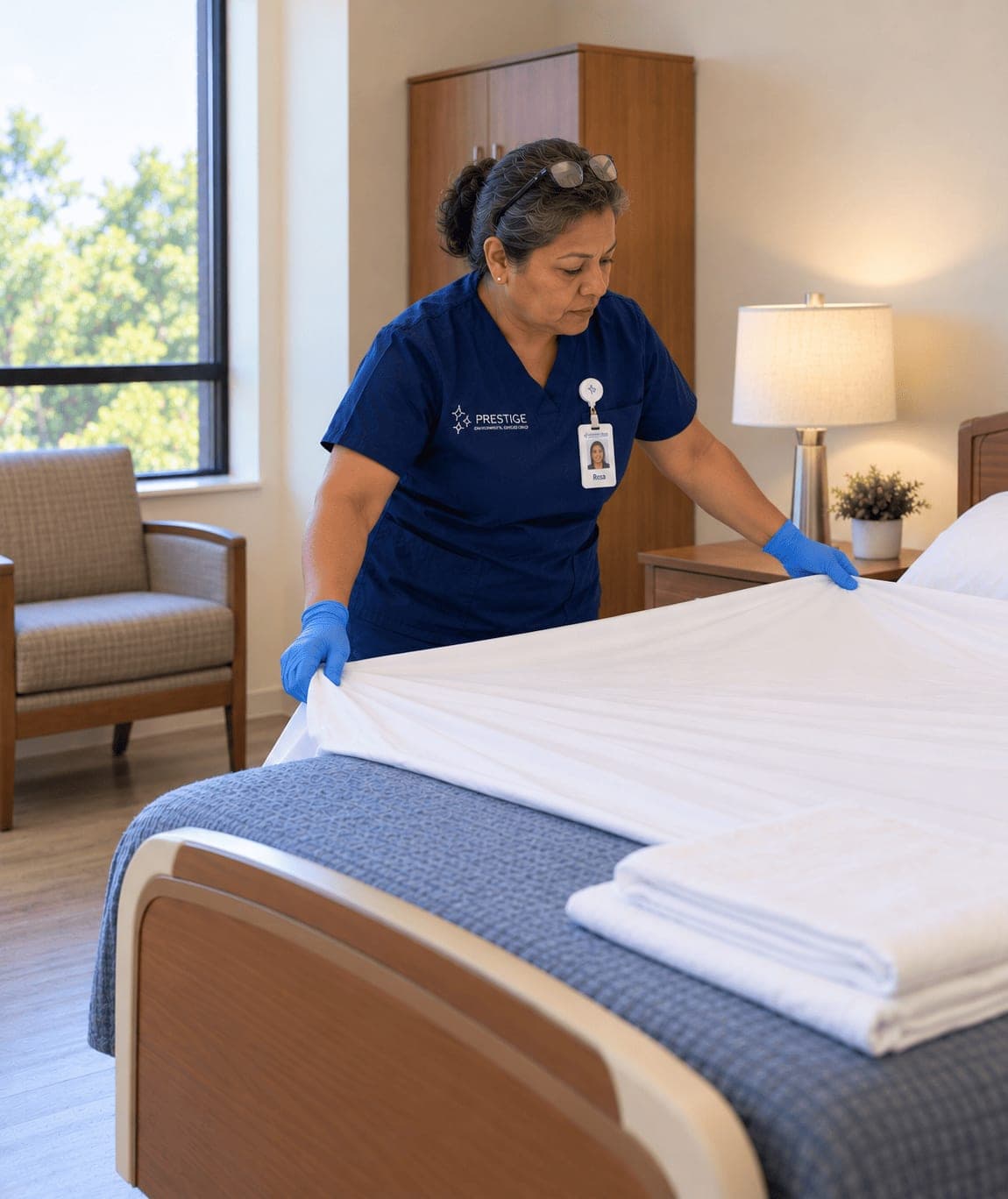
A resident room is not an office.
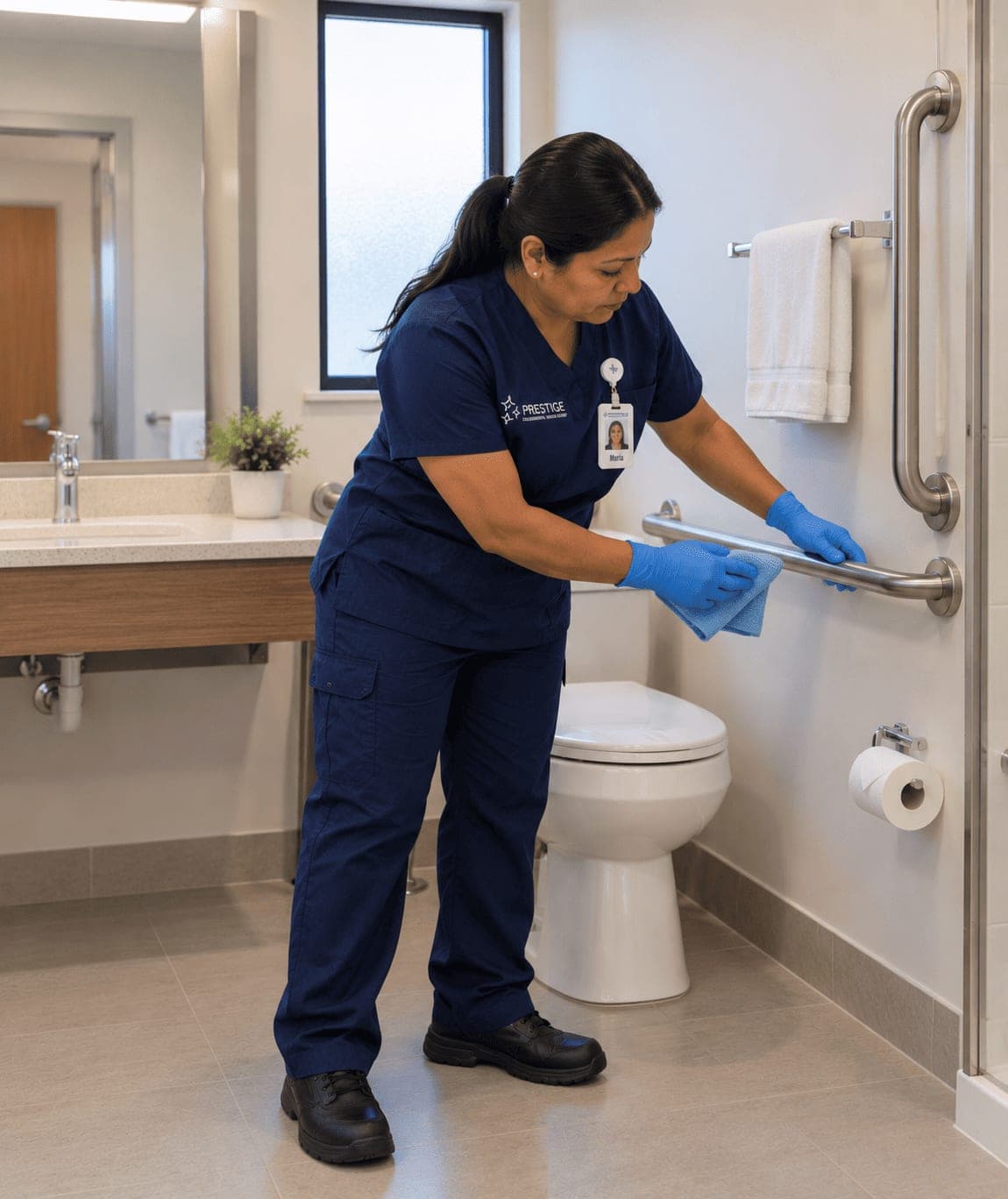
It holds medical equipment, personal belongings, and a set of high-touch surfaces that carry clinical weight — bed rails, call bell, over-bed table, grab bars, light switches and door handles. It is also a private residence, and the work is done around the person living in it.
So the work is sequenced, not improvised. Clean to dirty. High to low. High-touch surfaces disinfected with the correct product at the correct dilution and left wet for the full contact time on the label, because a disinfectant that is wiped dry in fifteen seconds has not disinfected anything. One cloth does not travel between rooms. The cart does not get left unattended in a corridor with chemicals on it.
None of this is exotic. It is simply what separates a housekeeping department from a cleaning crew.
Who is in the building
Structure is what makes a standard survive month six.
- 01
Housekeeping manager, on site
Full-time, in your building, accountable for the department. Builds the assignment sheets, runs the daily huddle, walks rooms behind the team, delivers the in-services, keeps the logs, and attends your QAPI meeting.
- 02
Assigned housekeepers on defined units
Each housekeeper owns a defined set of rooms and common areas. Ownership is what produces the small catches — a chipped baseboard, a curtain that needs to come down, a resident whose room smells different today.
- 03
A floor technician on the payroll
Floor care is a trade. We staff it as one rather than pulling a housekeeper off rooms to run a burnisher at the end of a shift.
- 04
Laundry aides who work in the laundry
The laundry is not an overflow assignment. It is a staffed position with its own process, its own logs and its own par targets.
- 05
A regional director above the manager
Housekeeping managers report to a regional director who is in your building regularly, reviews the records, and is the escalation point above the site. Problems surface through our chain of command, not through your complaint.
- 06
Coverage built around how the building runs
Shifts follow census, meal service, therapy schedules and admission patterns. Weekend and evening coverage is scoped up front rather than discovered later.
Documentation
Clean is the minimum. Documented is the standard.
Our room-level record is signed by the housekeeper who did the work and initialed by the supervisor who checked it. It captures room number, date, time in, time out, housekeeper name, signature, supervisor initials and notes — including a note when a resident refuses entry, which is the single most common reason a room shows as uncleaned and the single most useful thing to have in writing.
- Daily room cleaning sign-off, room by room, submitted to the supervisor at the end of every shift
- Refusals and inaccessible rooms recorded in writing rather than left blank
- Pest sighting log — date, time, room or unit, pest observed, person informed, housekeeper — logged and escalated the same day
- Supply usage log by item, quantity and location type
- Common area and public space rounds
- In-service attendance records held at the facility
- Monthly summary to the administrator
Scope and frequency
What gets done, and how often.
Daily
- Resident room cleaning, including high-touch disinfection
- Resident bathrooms and bathing rooms
- Corridors, handrails and elevator interiors
- Dining rooms between services
- Public restrooms, checked and restocked on a set round
- Trash and linen collection to soiled holding
- Auto-scrubbing of corridors
- Nursing stations, therapy and activity rooms
Weekly / scheduled
- High and low dusting, vents and ledges
- Burnishing on scheduled corridors
- Resident room deep cleans on a rotating cycle
- Storage and utility room organization
Periodic
- Discharge, transfer and terminal room turnover, on demand
- Deep cleaning cycles including walls, drawers, closets, dining furniture and curtains
- Mattress and wheelchair deep cleaning
- Floor care program milestones — see Floor Care
Frequencies vary by contract and building type. This list is representative of standard scope; the contracted schedule of work governs.
Infection prevention
Not a separate program. The method itself.
Infection prevention is not a separate program that runs alongside housekeeping. It is the housekeeping method. Product selection and dwell time, color-coded microfiber so a bathroom cloth never reaches an over-bed table, isolation room procedure and PPE sequence, terminal cleaning after a discharge, hand hygiene at the point of care, and soiled linen handled as though it is infectious because that is how the standard treats it.
Start here
Tell us what your facility needs.
We walk the facility with your administrator, director of nursing or environmental services director, review the current scope, the linen position, the condition of the floors and the state of the documentation, and put the whole scope in writing.