
The decision is not which contractor. It is whether to carry the department yourself.
Most housekeeping and laundry departments in long-term care are still
run in-house. Before comparing vendors, it is worth being precise about
what in-house actually costs.
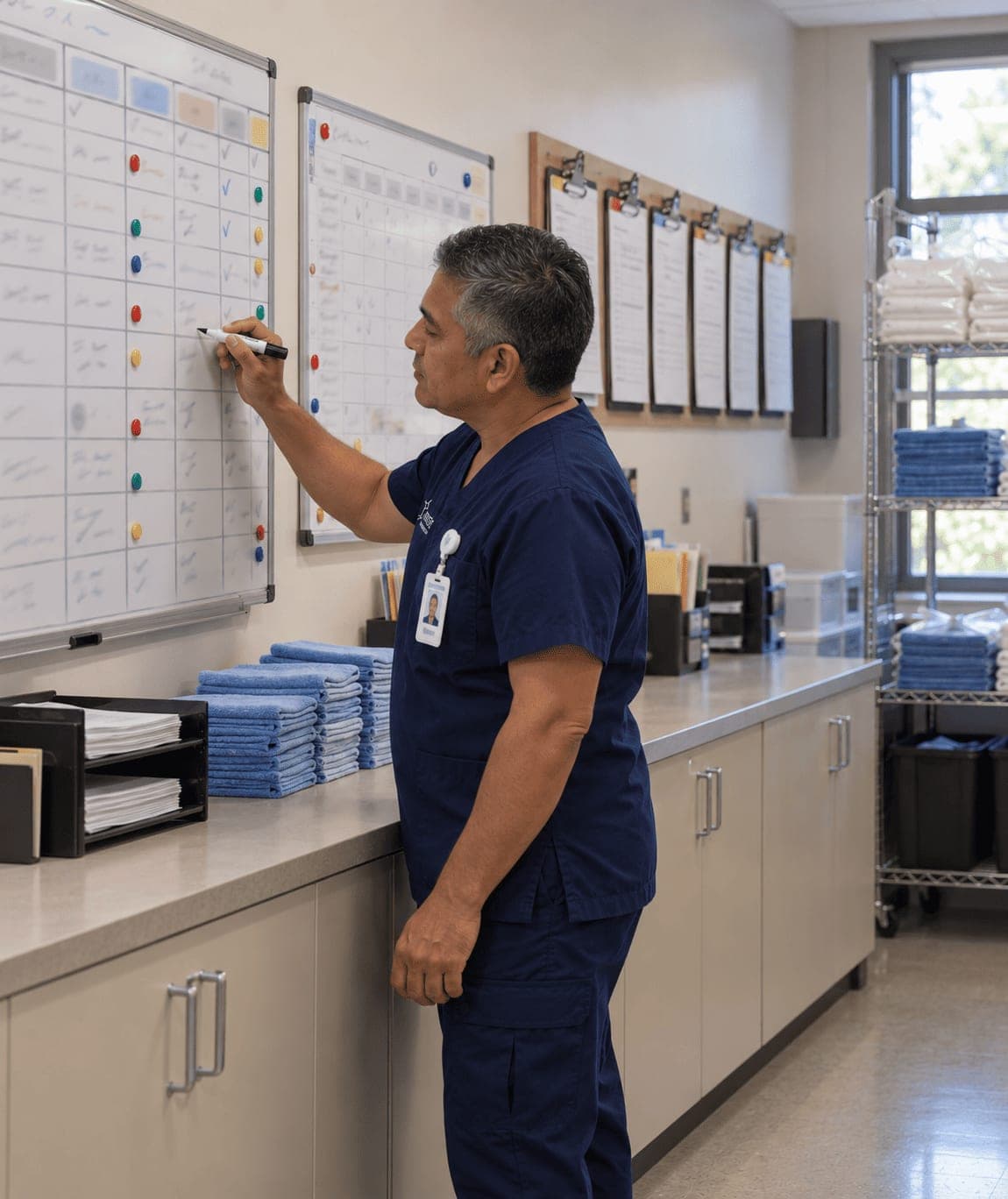
The wage line is not the cost
Housekeeping is budgeted as wages and consumed as management.
When a department is in-house, the budget line shows hourly wages and supplies. The actual cost of carrying it sits in a dozen other places on the P&L and in the administrator's week.
We do not publish a savings percentage, because the honest answer depends on your wage market, your census, your benefit load and how your building is currently staffed. What we will do is build the comparison with you, line by line, using your numbers.
What usually gets left out of the comparison
- Benefit load on housekeeping and laundry headcount
- Workers' compensation, which carries a different rate for housekeeping and laundry classifications than for administrative staff
- Unemployment cost, driven by turnover in the highest-turnover department in the building
- Overtime absorbed when a shift is short, and the premium paid for agency coverage when it cannot be
- Recruiting, onboarding and screening cost, repeated at whatever rate the department turns over
- The housekeeping supervisor's salary and the cost of the position sitting vacant
- Training delivery, in-service scheduling and the record keeping that proves both happened
- Chemical and linen overbuy — the cost of a department with no par discipline
- Administrator and DON hours spent on a department neither of them was hired to run
Three ways to run it
In-house, a national contractor, or us.
All three are legitimate. They fail differently, and the differences are structural rather than a matter of effort.
- 01
In-house
You keep complete control and complete variability. Every callout, every resignation, every workers' compensation claim and every unemployment charge lands on your operation. It works well in buildings with a strong, long-tenured housekeeping supervisor. It works poorly the month that person leaves, and the department rarely recovers to where it was.
- 02
The national contractor model
Scale, standardized programs and a corporate structure behind the contract. The trade-offs are structural: the person accountable for your facility is usually a manager whose territory includes several others; scope changes route through a regional or corporate approval rather than a conversation; and the frontline workforce is often the same local labor pool you were already competing for, with the same turnover, now one organizational layer further from you. For a large system with its own EVS leadership, that can be exactly the right trade. For a single facility or a small portfolio, it usually means you are a small account inside a large machine.
- 03
Prestige
A dedicated housekeeping manager in your facility rather than across several. Scope decided by people you can reach the same day. The staffing, screening, training, workers' compensation and turnover risk carried by us. Healthcare only, so nothing about the program is borrowed from a commercial janitorial playbook. The honest limit of our model is scale. We are not the largest contractor in this category and we do not pretend to be. What we sell is proximity and accountability, and those are easier to deliver at our size than at theirs.
What outsourcing does not fix
Three things worth saying out loud.
You still hold the license. Contracting the department transfers the labor, the supervision and the systems. It does not transfer your regulatory responsibility, and any contractor who implies otherwise is selling something they cannot deliver.
A bad transition costs more than a bad incumbent. Most of the damage in this category happens in the first ninety days, which is why our transition process is published in full rather than described as a promise.
Cleaning does not fix a physical plant problem. If the flooring is at the end of its life, the fixtures are failing or the laundry equipment is undersized for your census, we will tell you during the walk. We would rather lose the scope than absorb a problem we cannot solve and be blamed for it in month four.
Closing
We will build the comparison with your numbers.
Bring your current housekeeping and laundry cost, your census and your staffing. We will walk the facility, price the full scope, and show you both figures side by side — including the case where the answer is that you should keep it in-house.