
Nobody works in your facility untrained.
In-service is performed and documented before anyone starts.
Not in week two, not caught up at month end.
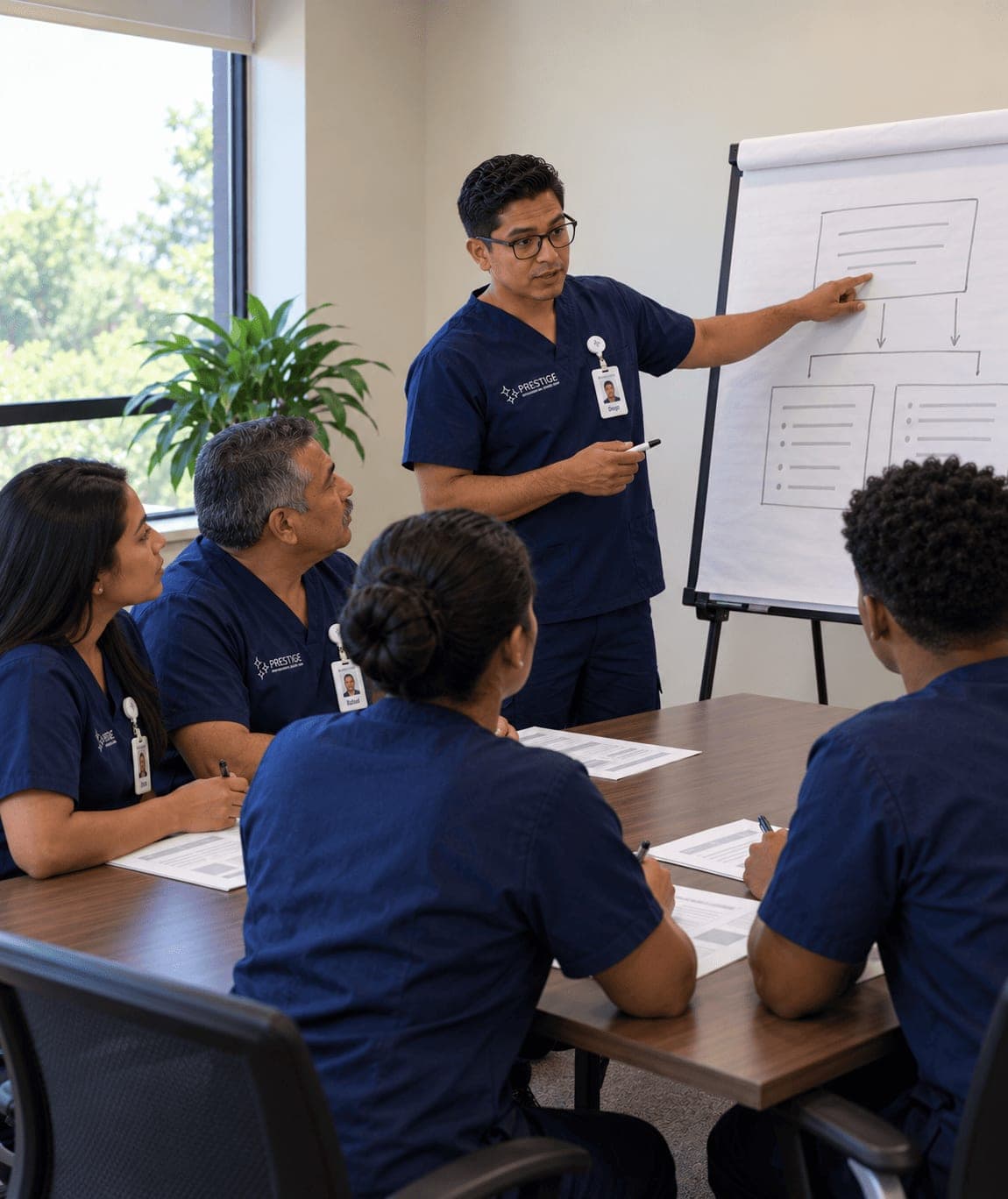
Why in-service is the whole game
In healthcare, training is not only a quality mechanism. It is evidence.
When a surveyor asks how staff were trained on isolation precautions, or what happened after a housekeeper was observed doing something wrong, the answer is a signed attendance record with a date on it.
Facilities are routinely cited not because staff were untrained, but because nobody could prove they were. We keep the proof on site.
So the rule is absolute. Orientation and the initial in-service are completed, tested, signed and filed before an employee works their first shift in your building. Not during their first week and not retrospectively. An employee without a completed and filed record is not on the schedule.
Pre-deployment orientation
Seventeen subjects, completed before a first shift.
- Infection prevention and control fundamentals, and the chain of transmission
- Hand hygiene
- Bloodborne pathogens and the OSHA standard at 29 CFR 1910.1030
- Personal protective equipment — selection, donning and doffing sequence
- Isolation precautions and precaution signage
- Hazard communication under 29 CFR 1910.1200 — labels, safety data sheets, and where they are kept
- Chemical selection, dilution and contact time
- Color-coded microfiber and cross-contamination control
- Cart discipline and chemical security
- Resident rights, dignity, privacy and knocking
- HIPAA awareness for non-clinical staff
- Abuse, neglect and exploitation — recognition and mandatory reporting
- Dementia awareness and approach
- Linen handling, clean and soiled
- Equipment operation and safety
- Body mechanics and back safety
- Emergency procedures, fire response and the facility's codes
The in-service calendar
Every month, at the facility, on shift.
Topics rotate through the core curriculum and are supplemented by whatever the building actually needs — a recurring audit finding, a change in facility protocol, an outbreak, a new product, or a survey result. Attendance is signed and the record stays on site.
Where a facility runs its own mandatory in-services, our staff attend those too. We are part of the building, not visitors to it.
Attendance is recorded and the record stays on site. Missed sessions are made up, not written off.
Safety
Chemicals, floors, dryers and backs.
Four things injure housekeeping and laundry staff and residents. All four are preventable with discipline.
- Hazard communication: chemical labeling, safety data sheets at the point of use, and handling trained under 29 CFR 1910.1200
- Chemical security: secured storage, no unattended carts, no decanting into unlabeled bottles
- Wet floor protocol: signage, half-corridor working and a walking route kept open at all times — a fall caused by our floor work is worse than a dull floor
- Bloodborne pathogens: exposure control, PPE, spill response and post-exposure procedure under 29 CFR 1910.1030
- Sharps awareness: staff trained never to reach into linen or waste, and to report and escalate any sharp found
- Laundry and dryer safety: lint traps cleaned every load and logged, dryer and vent condition checked, laundry cleaned down at end of shift
- Equipment safety: operating guidelines for powered floor equipment, cord management, pre-use inspection
- Body mechanics: lifting, pushing and pulling technique, and cart loading
- Emergency procedures: fire response, the facility's codes, evacuation role and resident assistance expectations
- Injury reporting: reported same shift, investigated, and reviewed for cause
Manager training
The manager is trained before the department is.
Every Prestige housekeeping manager completes training in bloodborne pathogens and biohazard handling, infection prevention and control, hazard communication and chemical safety, and healthcare environmental services procedure, before taking an account. They are the person who delivers your in-services, so their training is the ceiling on everyone else's.
Advancement
Training is also how people move.
Housekeeper to team lead. Team lead to floor technician or laundry lead. Lead to housekeeping manager. A department with a ceiling does not keep people, and a department that does not keep people cannot hold a standard.
Start here
Tell us what your facility needs.
We walk the facility with your administrator, director of nursing or environmental services director, review the current scope, the linen position, the condition of the floors and the state of the documentation, and put the whole scope in writing.