
Terminal cleaning, OR turnover, and a response time that holds at three in the morning.
Hospital environmental services is measured in minutes and audited
in outcomes. We staff and supervise it accordingly.
The standard we are held to
A sanitary environment is a condition of participation, not a service level.
For hospitals, 42 CFR 482.41 requires a physical environment that protects the health and safety of patients, and 42 CFR 482.42 requires the hospital to provide a sanitary environment to avoid sources and transmission of infections and communicable diseases, supported by an active infection prevention and control program.
Environmental services is one of the primary means by which a hospital meets that condition. That is why EVS staff belong inside the infection prevention program rather than alongside it — trained on the same protocols, audited on the same cycle, and represented in the same quality reporting.
Scope
What we staff, and to whose protocol.
- Patient room daily cleaning and high-touch disinfection
- Discharge and terminal cleaning against defined turnover targets
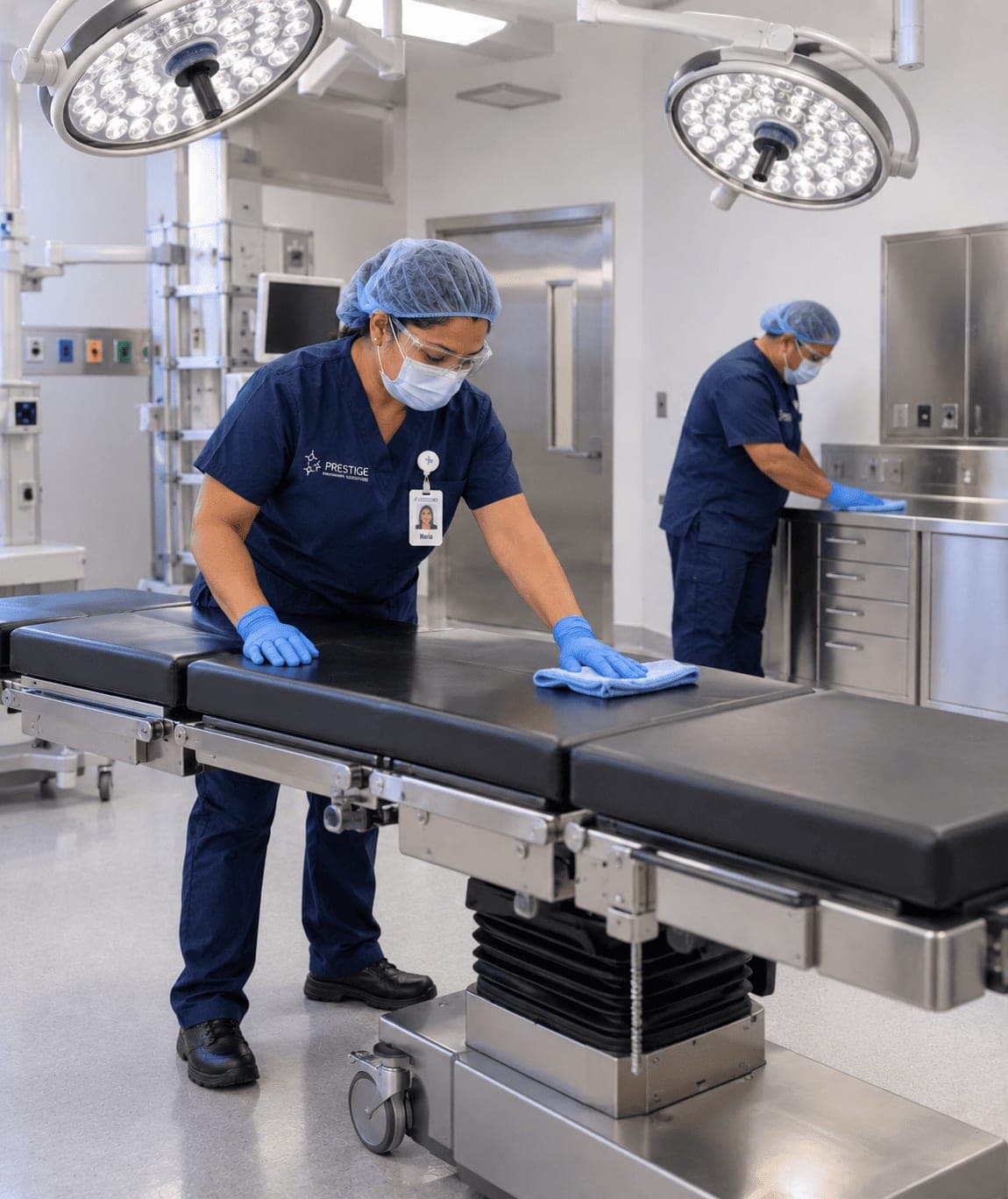
- Operating room turnover — between-case and end-of-day terminal cleaning, to the hospital's protocol and turnover time
- Cleaning of sterile processing and procedural support areas, to the hospital's protocol
- Isolation room cleaning by precaution type, including high-consequence organisms, to the hospital's protocol
- Emergency department and high-turnover area coverage
- Public areas, waiting rooms, corridors, elevators and restrooms
- Ancillary and support space cleaning
- Linen distribution and soiled linen handling
- Regulated medical waste and sharps handling, to the hospital's protocol
- Floor care programs scheduled around clinical operations
- Dedicated response coverage for spills and urgent calls
Training for the environment
Trained before they work a case.
Operating room and procedural area work is a separate competency, not an extension of floor cleaning.
Staff assigned to those areas are trained on the hospital's turnover protocol, traffic patterns and attire requirements, on terminal cleaning sequence, and on the disinfectants and contact times specified by the hospital's infection prevention program, before they work a case.
Measurement
You already measure this. We plug into it.
Hospital clients generally already measure what they need. We plug into it — turnover times, cleaning audit results, patient experience scores on room cleanliness, and infection prevention audit findings — and we bring our own room-level records alongside.
Start here
Tell us what your facility needs.
We walk the facility with your administrator, director of nursing or environmental services director, review the current scope, the linen position, the condition of the floors and the state of the documentation, and put the whole scope in writing.